Showing posts with label Facts. Show all posts

Tuesday, 21 March 2017

What's happening in Fusion? Part 2

Written by Sam Ha

In case people missed part 1, these posts are a small collection of questions and answers about what's happening in the world of fusion, especially looking to the future. Everyone is welcome to ask questions below, and I'll put together a Q&A post if there are enough questions and answers. Without further ado, the first question:

Q: So Why Is It Taking So Long?
This one is a classic and there are so many bits of the answer, but I'm going to try and keep this answer short.

The systems that we expect to be able to generate significant amounts of fusion power reliably are (by and large) magnetically confined fusion devices (MCF). What this means is that we turn a small amount of gas (generally two types of hydrogen) into the 4th state of matter: Plasma.

Plasma is a completely ionised gas and as such, can be controlled by magnetic fields. Early experiments in nuclear fusion (like these!) used simple magnetic fields to confine plasma.

Several problems that hinder our plans of fusion electricity have been discovered, but some of the most difficult have been due to confining plasma.

The plasma that we generate stores a huge amount of energy that must be well contained. The problem is that the plasma becomes very difficult to contain and over the years many types of plasma instabilities have been discovered. These instabilities cause the plasma to escape our magnetic trap and collide with the walls. When this happens there is a considerable amount of damage. To the plasma, of course. The walls can also be damaged, but there's several hundred kg's of the wall and only a couple of grams of plasma, and the plasma always comes off worst in a fight.

Therein lies one of the problems with fusion: plasma is very difficult to control. The physics behind these instabilities are also very complicated, but there are a number of experiments being carried out around the world that are investigating how these instabilities arise and what we could do to get rid of them.

However, we have made some good progress in the meantime: a common measure of how effective a fusion device is, is something called the Triple Product. This is the go-to way of measuring the performance of fusion devices and we've been able to improve the triple product of machines at an astonishing rate, even outpacing the rapid development of computer chips (often called Moore's Law)

Q: Tokamaks are cool and all, but what about Stellarators or Laser Fusion?
Stellarators were initially researched alongside tokamaks in the early days, mainly in America. The design of a stellarator was a strike of brilliance to counteract particles drifting out of their orbit around the torus, by way of some clever arrangement of the magnetic fields. 

In comparison, tokamaks require the plasma to carry a current, which is most commonly achieved by one, large magnet in the centre: the central solenoid. In many cases, this is a limitation that forces tokamaks to be pulsed machines, requiring regular stops and starts. For fusion research to this point, the limitations of short pulses (<1 minute) hasn't stopped developments, but in the future, continuous operation will be much more valuable. Regularly stopping and starting powerful machinery is a good way to break it quickly!


The initial trouble of designing stellarators without powerful computers and the good results from tokamaks led to the majority of effort being placed on tokamaks. Now, stellarators (like Wendelstein 7-X) are seeing a resurgence as the design of large, complex reactors has become possible thanks to significant increases in computational power.
And now to talk about Laser Fusion! This is a form of Inertial Confinement Fusion (ICF) and fuses hydrogen pellets by imploding them on all sides using really powerful lasers (really cool, all around). The American National Ignition Facility (NIF) excels at this.
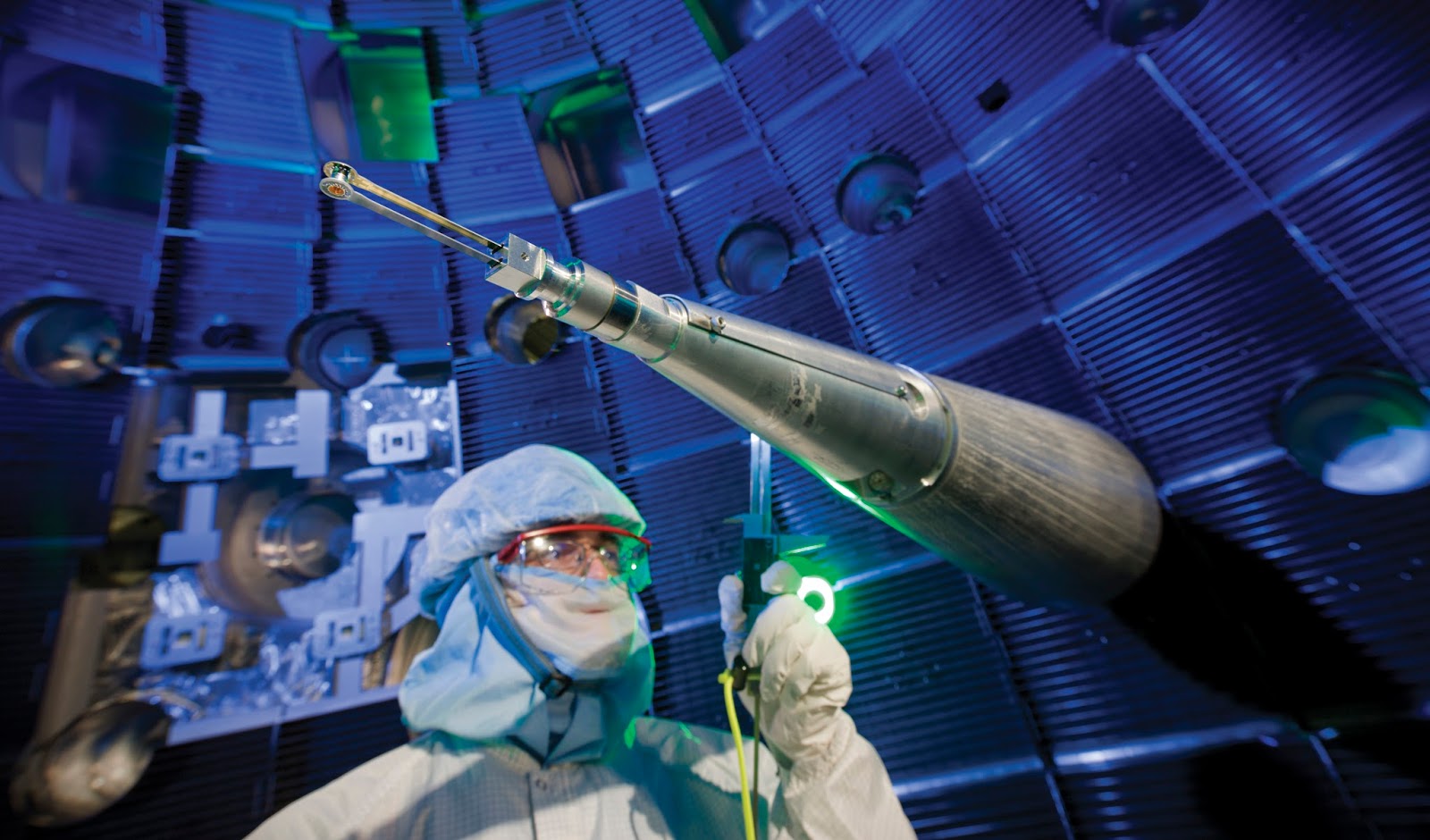

NIF recently announced they had reached an important milestone never before seen: they achieved breakeven conditions during a controlled reaction. The main goal of ITER is to reach breakeven conditions in an MCF device, so one thing is definitely clear: this is a monumental achievement. 

What does it mean for producing a fusion power plant? Well, that's a little harder to answer. Firstly, the breakeven conditions are considering the energy absorbed by the small, hydrogen pellet, which is <1% of the total laser pulse energy. Secondly, to generate significant amounts of energy, a regular reaction rate is required, while NIF aims to have 400 pulses in the entire year. 

The road to a fusion power plant using lasers isn't a smooth one and I'm eager to see the achievements from NIF. I'm not expecting to see a laser powered fusion power plant for a similarly long time to a tokamak power plant.

Q: What about after DEMO?
DEMO is the Demonstration Power Plant, designed to prove the viability of a tokamak power plant putting Fusion electricity on the grid (see Part 1 for more details). DEMO isn't the end of the road for fusion research, in the same way that the first fission power plant wasn't the end of the road for fission research. There are advanced reactor designs that have gaps that need to be filled in by ITER and DEMO, such as radiation tolerant materials.

One area that I'm very excited about is the design of so-called hybrid reactors. These reactors find a harmony between fusion and fission, to make a fusion reactor that can get rid of waste from and make new fuel for fission reactors, while reducing the complexity and difficulty involved in making a fusion reactor. Designs of these types of reactors can't be properly evaluated and developed for manufacture until a fusion reactor is up and running, so that they can be demonstrated to be safe to a regulatory body. Hybrid reactors are not a focus for UKAEA, or in the UK in general, but are being seriously investigated in other countries.

Next Time
Questions from readers!

Wednesday, 1 February 2017

What's happening in fusion?

Written by Sam Ha

Some of the questions I had when I began looking into fusion research were surprisingly difficult to get answers for. That's not because the answers are closely guarded (pro tip: they're never closely guarded in fusion). I was just asking the wrong questions or the wrong people. I wanted to put together some of these questions and answers to help any readers that might be curious.

(If people have any questions that this doesn't answer, please please PLEASE ask in a comment or message or e-mail to samuel.ha@ukaea.uk)

I'm going to write this in parts, so if you have any questions, feel free to ask them in comments or e-mails and I'll write a Q&A if there are enough questions.

Part 1: The plan for fusion research
Curious-university-student-Sam wanted to know what the plan for fusion research was: which machines are going to be built, when and why. This part covers some of the information about what research is planned

Q: When will I have a fusion power plant?
A: This question is all too common and there are various answers depending on who you believe, but I'm going to try and keep it simple: in Europe, the plan (or EUROfusion Roadmap) is to begin building a Demonstration Fusion Power Plant (known as DEMO) in the 2030's and put Fusion electricity on the grid in the 2040's; widespread commercial deployment can only come after successful operation of DEMO.


Q: How definite is this?
A: We could have electricity from fusion reactors a long time after or before the EUROfusion roadmap's target of the 2040's. Why is this?

Firstly, the roadmap is a long term goal with a lot of unknowns, and ITER is being designed to eliminate a lot of these unknowns. The long and short of it is that ITER is a really complicated machine being built in an even more complicated way and has been delayed multiple times. This could have a knock on to delay the design of a DEMO reactor and increase the time to fusion electricity.


Secondly, ITER isn't the only reactor that we could use to understand some of these unknowns. There are lots of ideas being tried and some other very advanced reactors being built that can help develop our knowledge.

Thirdly, the EUROfusion roadmap is the research stream representing 26 EU member states (+ Switzerland!), whereas fusion research happens all over the world! Other research is being carried out in Japan, China, Korea (who partner with many US researchers), Russia and India, to name a few countries. Korea want to build their reactor by 2037 and China want to build an electricity generating reactor even sooner, called CFETR (Chinese Fusion Engineering Test Reactor).

CFETR not only generates a lot of fusion power (200MW, compared to 500MW in ITER and a 'measly' 16MW in JET), but it has something called a Breeder Blanket which creates more fuel for the reactor and turns the fusion power into useful heat, which can be used to produce electricity. CFETR isn't intended to be as groundbreaking as a DEMO in some important ways, so could take a lot less time to build. That doesn't change the fact that CFETR could be the first device to be able to produce large amounts of electricity from fusion reactions, and that makes me very excited for this machine in particular.


Q: So who's looking into what?
A: Everyone's looking into everything, more or less. There are many designs of DEMO fusion reactors and everyone has a name for theirs: In Europe, we call ours EU-DEMO and Korea call theirs K-DEMO, other names are similarly imaginative.

As an example, a big area that needs developing is materials (an introduction to the problem was covered by our own Alex and Jim!)

European researchers have been developing a special type of steel for several decades now, called Eurofer, which is a type of Low (or Reduced) Activation Ferritic/Martensitic Steel (RAFM). China have also been developing a similar material, called CLAM (Chinese Low Activation Martensitic steel). India have too. So have Japan.

Obviously, I'm oversimplifying the process of materials research and I'm doing a great discredit to the all of the teams I just mentioned, by implying they're all doing the same thing. The reality is that there are subtle and not so subtle differences and each team's working with their own constraints and goals, but the outcome is that many of the countries contributing to ITER are each researching their own low activation, ferritic/martensitic steels.

And the reason is simple: we're all working towards the same goal and each trying to develop fusion technology in a way that people can benefit from. The developments that each country make are made in the spirit of collaboration.


Next time:
So why is it taking so long?
Tokamaks are cool and all, but what about Stellarators or Laser Fusion?
What about after DEMO?

Friday, 27 February 2015

Can Nuclear Fusion save the world?

When some of the graduates went to the KIT summer school on Fusion technologies last year (see blog post here), David Ward from CCFE gave a talk entitled ‘Future Energy and the Role for Fusion’. As well as leading CCFE’s Power Plant Technology Unit, David works at the Oxford Institute for Energy Studies, so is well placed to give an overview of fusion’s place in the energy market of the future. It was so well packed with interesting facts and figures that I thought I would convert his talk into a blog (with his permission!)
 
Future outlook
 
Most people are aware of the dire consequences facing the world at the moment due to global warming.  We’re beginning to see more and more examples of extreme weather globally and this has been partly attributed to all of the carbon dioxide that developed countries have emitted since the industrial revolution. Unfortunately the areas that usually get hit the hardest by this extreme weather are developing countries: nations that have contributed the least to these effects.

The graph below (Fig 1) shows the HDI (Human Development Index – a measure of GNP, health, education, etc.) for all OECD (developed) and non-OECD (developing) countries.  For all developing countries to reach the same HDI as the UK for example (~0.9), the world’s energy use would need to double, not accounting for any population increase. 

Figure 1


Figure 2 shows a graph of the energy consumption in Germany, China and India from 1965 until 2010. It shows that in just the final two years the growth in Chinese energy consumption has equalled the total energy consumption by Germany since 1965. Developing countries are becoming a match for energy consumption from developed countries. We must reduce emissions if we are to minimise climate change, yet we are faced with a massive increase in demand for energy. Decoupling this paradox will require dramatic changes in energy systems.
 
How can fusion help?
 
Renewable energy is making progress, and is steadily forming a larger proportion of energy production. In 2013 renewable energy contributed 15% to UK electricity compared to 11% the year before. Renewables have an extremely important part to play in our future, but many of them rely on certain weather conditions (solar, wind) and at the moment we do not have a viable energy storage solution (although progress is being made). Nuclear fission provides a reliable baseline energy supply with low carbon emissions, and fusion has the potential to do the same in the future, with even more advantages.
 
One of the fuels used in fusion is deuterium, which occurs naturally in water. A single litre of water contains 0.033g of deuterium, possessing energy equivalent to 10GJ or 280 litres of oil. There is enough deuterium around to provide energy for billions of years. The other fuel is tritium, which can be produced from lithium. The amount of lithium in one laptop battery would be enough for one person’s lifetime of electricity needs (240,000kWh). There are land based lithium reserves for at least thousands of years (from known supplies) to millions of years (from expected but unconfirmed reserves). The bottom line is that fuel reserves for nuclear fusion are enormous and not an issue.
 

Nuclear fusion is inherently safe – there is no chance of a ‘run-away’ reaction. Tritium is radioactive but has a short half-life of 12.5 years, so it decays quite quickly (long-lived fission products have a half-life of up to 200,000 years). It’s useful to put the amount of radioactivity we experience in our day-to-day lives in perspective. Figure 3 shows the amount of radiological exposure arising from activities which give us energy. The two highest doses are from food, and from improved double glazing – both of which go off the scale of the graph. Food is naturally radioactive, and double glazing increases our dose by introducing more radon into our homes. This graph is just to give context, and not compare means of energy consumption. None of these sources give us a damaging amount of radiation.

Figure 4 shows a 2007 prediction of the lifetime of various energy sources, assuming current demand. There is data for oil, gas, coal, uranium (for fission), breeder (for advanced fission) and lithium (for fusion). For each there is a ‘lower resource’ - what we know we have, an upper resource - what we think we may have, and ‘new’ resources - speculative considerations. These data are rather out of date, and do not include shale gas reserves but give a good overall idea of the future we face. Oil, gas and coal are probably going to run out very soon, and even if they don’t we need to curb their usage. Even uranium for fission doesn’t give us a very long outlook. Advanced fission reactors and fusion would see us far into the future, with very low carbon emissions. 


Fusion’s bad press

There are lots of good things about nuclear fusion, and when we get it working, it has the potential to largely solve our energy problems. However, it has had rather a bad press in the last few years. The typical joke is that ‘fusion is always 30 years away’. What rarely gets reported is how much progress we have made in fusion, the technologies that have advanced due to fusion research, and how much we now understand relative to even 10 years ago. What often gets reported is that we have an international project called ITER, which will be the largest fusion reactor so far, and for which construction has overrun and has gone over budget. This is true, and the management of the project is now being reorganised to address these problems. The estimated total cost of ITER is 15 billion euros, which is a huge amount of money, but it’s interesting to compare this to other costs. The total cost of ITER amounts to the same world expenditure on two days’ worth of oil. Figure 5 shows the estimated amount spent globally on different energy sources. Overall, the amount spent on public sector research and development is a negligible fraction, and of that, fusion is a tiny fraction.
 
 
The Future
 
If we consider hypothetical future energy scenarios, in a world where there is no constraint on carbon emissions, we are totally dependent on coal and fission. In a low carbon future – fission and renewables provide the growth needed for about 50 years. After that, fission needs to be replaced by ‘advanced nuclear’ which includes fast breeders and fusion. Alternatively, fission may be constrained due to public concerns and fusion may be required earlier. However, if fission is rejected by the public, it is uncertain whether fusion will be more or less likely to contribute meaningfully.

World energy consumption is likely to more than double, even with a cap on it. There is therefore an enormous potential market for low pollution, low carbon energy sources. Fusion has huge benefits in terms of resources, environmental impact, safety and waste materials. Those doing research into fusion power must focus on demonstrating its potential as a power source, ensuring the benefits are optimised and keeping costs reasonable. If we are to achieve the transformation required in energy markets, the world needs to invest much more in fusion and in energy research and development as a whole.

For more information please see David Ward’s publication

Tuesday, 21 October 2014

KIT Summer School Factfile

From our experience at the KIT Summer School (see the full blog post here) we compiled a list of interesting facts about FUSION that we learnt, and also facts about GERMANY.

 Fusion Factfile 

1. The TF coils in ITER will store over 40GJ of magnetic energy! That’s 15 times the kinetic energy we store in our massive flywheels at JET. 

2. I was surprised to learn that the Lorentz force generated by the maximum current planned for one of ITER’s TF coils would cause them to collapse if they were self-supported. 

3. The assembly tolerances for the ITER vessel and magnets are phenomenally tight. This will be an incredible feat of engineering when they achieve it.

4. Stellarators look freakin’ awesome 


5. The ITER toroidal field coils will contain 150,000km of superconducting strands – enough to stretch over 3 times around the circumference of the earth.   

6. Super conductivity is really clever! But making superconducting magnets seems painfully difficult. High temperature super conducting materials are going to be really important for future fusion devices. 

7. KIT have the largest tritium lab in Europe and are the only lab capable of conducting tritium research for ITER. ITER will weigh 27,000 tonnes (3 times Eifel Tower).
 
    8. Cryopumps don’t actually “pump” anything! They work by condensing all the gas molecules onto a very cold surface, which periodically has to be regenerated by heating it up  - just like your freezer! This makes long-term continuous operation a big challenge for DEMO.

9. ITER will be testing out 6 different breeder blanket concepts to see which one works best.

10. The Tore Supra tokamak has an 8-metre long ‘Articulated Inspection Arm’ which is fully integrated in the tokamak vacuum. An inspection can be done after every pulse without interrupting the vacuum! 

 
Germany/KIT Factfile
 
    1. Karlsruhe’s beautiful palace gardens are open to the public every day; for free! 


    2. If you are not used to Steins, be careful not to drink them like a pint…  

    3. There’s a free shuttle bus between KIT south and north campus, which is very convenient! 

    4. German cycle commuting is awesome! Much better infrastructure for cycling, and European style commuter cycles (rather than sport oriented cycles) are actually a lot better than I had expected – really easy for commuting with.
  

5. Mike from Mike’s Bikes: what a dude. He will rent you a bicycle for around 10 €/day. Do it. Cycling through the forest, along beautifully smooth cycle paths to and from the KIT campus is sweet. Beats the bus.  

6. Karlsruhe was dreamt up by Charles III William in 1700s during a nap – he designed the city to look like the sun radiating from the palace in the east. 

7. It’s easy to buy really good non-alcoholic wheat beer and non-alcoholic cocktails at almost all restaurants and bars. 

8. Don’t forget to ask for a receipt at the KIT canteen 

9. When you’re packing to go to the KIT summer school leave room for about 2kg of lecture notes and 2 or 3 bottles of souvenir wine. 


10. Three-course meals every night take their toll. Germany is very good at providing individual receipts. 

11. The free KIT wi-fi is also available at the Studentzentrum on the south campus (i.e. where the shuttle bus stops), and in the grounds in front of the palace in the city centre (Karlsruhe Schloss) 

12. “Europabad” is well worth a visit. 

13. Sometimes German transport isn’t on time!